



04 Feb Let me interrupt: the missing skill in Voice AI
Despite the influx of AI models, voice remains the single biggest mode of interaction in healthcare and financial services. Many startups now advertise a voice agent that can handle calls in minutes. While the core technology—text-to-speech conversion, low-latency processing, and customizable voice options—is rapidly becoming commoditized, these advances obscure the most critical challenge: delivering a near-human experience.
Humans Like to Interrupt—Immediately
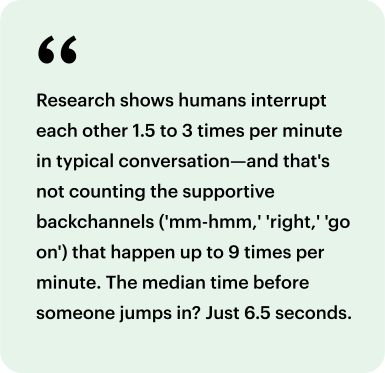 You might not realize how natural it is to interrupt someone in the middle of a conversation until you talk to an AI agent. Being forced to wait through an entire response before you can speak would be insufferable in a human interaction. Our instinct is to jump in, redirect, or clarify mid-thought, yet most voice AI today doesn’t work that way. Chat widgets, phone bots, and most voice assistants are linear. You speak, they process, you wait, they reply. If you interrupt, they ignore you, break, or start over. For frustrated consumers, it’s often a conversation-breaker and a deal-breaker. This is why fewer than 8% of Voice AI implementations are considered successful.
Why Interruption Matters
Humans naturally interrupt, rephrase requests, and reframe their needs mid-conversation. Sometimes we interrupt to clarify, confirm, or redirect. Voice AI systems must immediately stop their audio output, accept new input, process it with minimal latency, and redirect the model to reframe its answer. When combined with capable language models, this transforms interactions from robotic and tone-deaf to something genuinely conversational. A healthcare voice agent that responds cheerfully but woodenly when a patient describes symptoms is destined to fail. The ability to interrupt and receive an adaptive response demonstrates that the AI is listening—and gives users a sense of control. Both are prerequisites for building trust.
The Technical Challenge
For decades, humans have adapted to machines: waiting for blinking prompts, clicking through menus, rephrasing questions to fit rigid interfaces. Now, interruptibility lets machines adapt to us—matching our natural conversational flow. Companies like Avaamo have spent years solving the technical challenges that make this feature deceptively difficult. Let’s break down the problem:
Streaming speech recognition: The system must transcribe speech continuously in real time to catch interruptions. Any delay, and the AI steamrolls ahead.
Model streaming with interrupt handling: Large language models generate responses token by token. Cutting them off mid-generation without producing incoherent fragments requires careful orchestration.
Synchronized audio pipelines: Text-to-speech engines buffer audio. To stop speaking the instant you cut in, the audio pipeline must flush instantly and revert to listening mode.
Contextual prosody and emotional intelligence: Traditional text-to-speech models lack the contextual awareness needed for natural conversations. There are countless valid ways to speak a sentence, but only some fit a given moment. Without understanding tone, rhythm, and conversation history, the AI can’t choose the right delivery, resulting in responses that feel flat or inappropriate.
Full-duplex conversation modeling: Human conversations involve complex turn-taking, pauses, and pacing that current models struggle to capture. Most systems operate in half-duplex mode (one speaker at a time), but natural dialogue requires models that can listen and speak simultaneously while learning conversational dynamics from data.
Enterprise security: Role-based permissions, audit trails, and data residency requirements complicate deployment.
Each of these elements must be tuned to work together. Companies like Avaamo have invested years of fine-tuning to combine them into a seamless, secure, interruptible agent.
See how Ava, our healthcare scheduling agent handles interruptions
The Shift Ahead
2026 will be the year buyers move beyond the “features” checklist and start evaluating Voice AI on something harder to measure: fluidity. Until now, voice agents were judged primarily on outputs—did it complete the task? Going forward, how the system handles the messy middle of conversation will matter just as much as speed and cost. Users will engage more deeply with systems that let them steer and reframe in real time, at their natural cadence. And these shifts will show up where it counts: satisfaction scores, abandonment rates, and session duration.
