






01 Aug The millisecond that decides whether a caller trusts your AI agent
I’ve spent years watching enterprises wrestle with the same tradeoff: deploy AI voice agents and gain efficiency, or keep humans on the line and keep the conversation feeling natural. For most of this industry’s history, that tradeoff has felt unavoidable. You could have scale, or you could have warmth, sadly not both.
Today, we’re retiring that tradeoff.
We just shipped eight new capabilities across Avaamo’s AI first contact center, and they all attack the same enemy: latency. Not latency as a benchmark on a slide, but latency as the thing a caller actually feels: the half-second of dead air that tips them off that they’re talking to a machine, the awkward interruption, the flat, robotic response that arrives a beat too late to feel human.
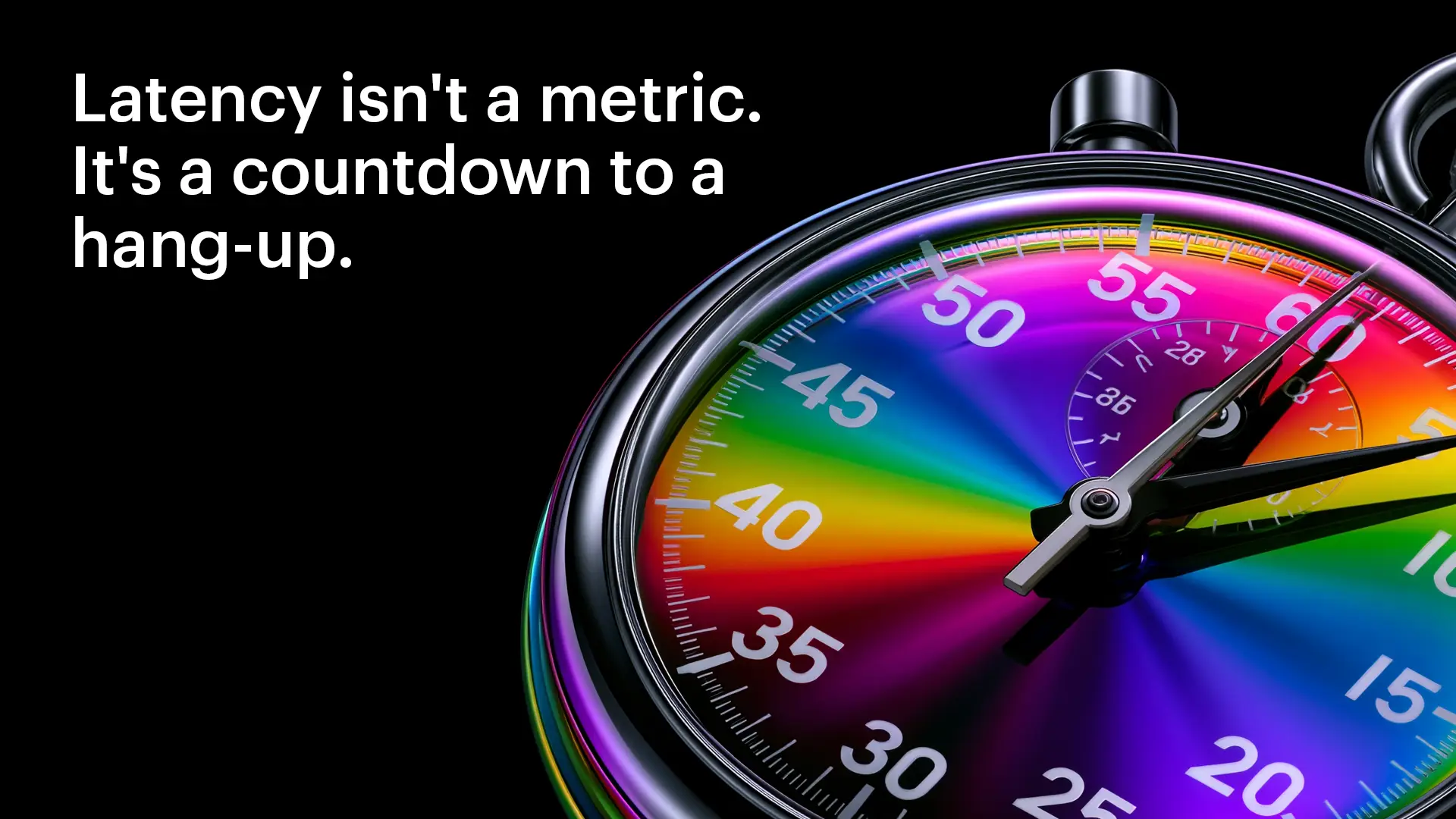
Our CEO Ram Menon put it well: “Latency isn’t a technical metric. It’s the difference between a caller who trusts your AI agent and one who hangs up.” That’s the thesis behind this release. We didn’t set out to shave milliseconds for the sake of a scoreboard. We set out to remove every moment in a conversation where the illusion breaks.
Here’s what that meant in practice, across the full lifecycle of a call.
Before a word is spoken
With Pre-Call Intelligence, we use metadata that’s already available — phone number, ANI — to run backend lookups and authentication in the background, before a word is spoken. The first turn isn’t just fast. It’s already personalized.
Listening the way a person would
Dynamic Listening throws out the old fixed silence threshold. The system now adjusts how long it waits based on what it’s actually collecting — a longer pause for someone reciting an address, a shorter one for a date of birth. That’s the difference between a system that cuts people off and one that actually listens the way a person would.
No more “can you repeat that?”
Callers rarely give you a clean, single-turn answer. Multi-Turn Response Stitching assembles a complete data entity across fragments, so nobody has to repeat themselves because the system lost the thread.
When the caller talks over the agent.
This is the one I think matters most for full-duplex conversations. Turn Overlap and Response Reconstruction captures a mid-stream interjection, re-queries the LLM, and rebuilds a coherent response on the fly so a correction or a new detail never gets lost just because the caller jumped in.
Speaking before the thought is finished
Direct LLM Streaming pipes output from our LLamB™ engine straight into text-to-speech, so the platform starts speaking while the model is still thinking. It’s a Time-to-First-Byte optimization, and it’s one of the biggest levers on perceived latency we have.
One voice, start to finish
Consistent Vocal Fingerprinting keeps pitch and tone normalized across every syllable. Disjointed speech fragments are one of the fastest ways to fall into the uncanny valley — this keeps the vocal persona seamless.
Hearing through the noise
Multi-Modal Noise Cancellation strips background noise and chatter at the edge, before it ever reaches the ASR engine, so accuracy holds up in the messy, real-world conditions contact centers actually operate in.
Making silence feel natural
Optional Ambient Sound uses psycho-acoustic masking to layer in realistic contact-center ambience during heavier processing moments. Silence reads as suspicious; a little natural background noise reads as human.
Try a live demo of an AI voice agent
The bigger picture
Individually, each of these is a meaningful engineering improvement. Together, they’re something bigger: an AI agent that doesn’t just answer correctly, but responds the way a great human agent does — attentively, fluidly, without the tells.
That’s the bar we’re building toward. Not “good enough for AI.” Just good.
These capabilities are available now as part of Avaamo’s AI-first contact center.
