





03 Sep The AI-First Playbook: Crawl, Walk, Run
The contact center has a structural problem, and it is not the one most people think it is.
The standard diagnosis goes something like this: IVR menus are frustrating, hold times are too long, agents are undertrained, and customers are unhappy. All of this is true. But these are symptoms. The structural problem is that the entire model was designed around a single constraint: human agents are expensive, slow to hire, and impossible to scale. Every design decision in the traditional contact center follows from that constraint. The IVR exists to keep customers away from agents. The hold queue exists because there aren’t enough agents. The language menu exists because each agent only speaks one or two languages. Quality assurance samples 2% of calls because nobody can listen to all of them.
The traditional contact center is not, if you think about it clearly, a system designed to serve customers. It is a system designed to ration access to humans.
The false binary
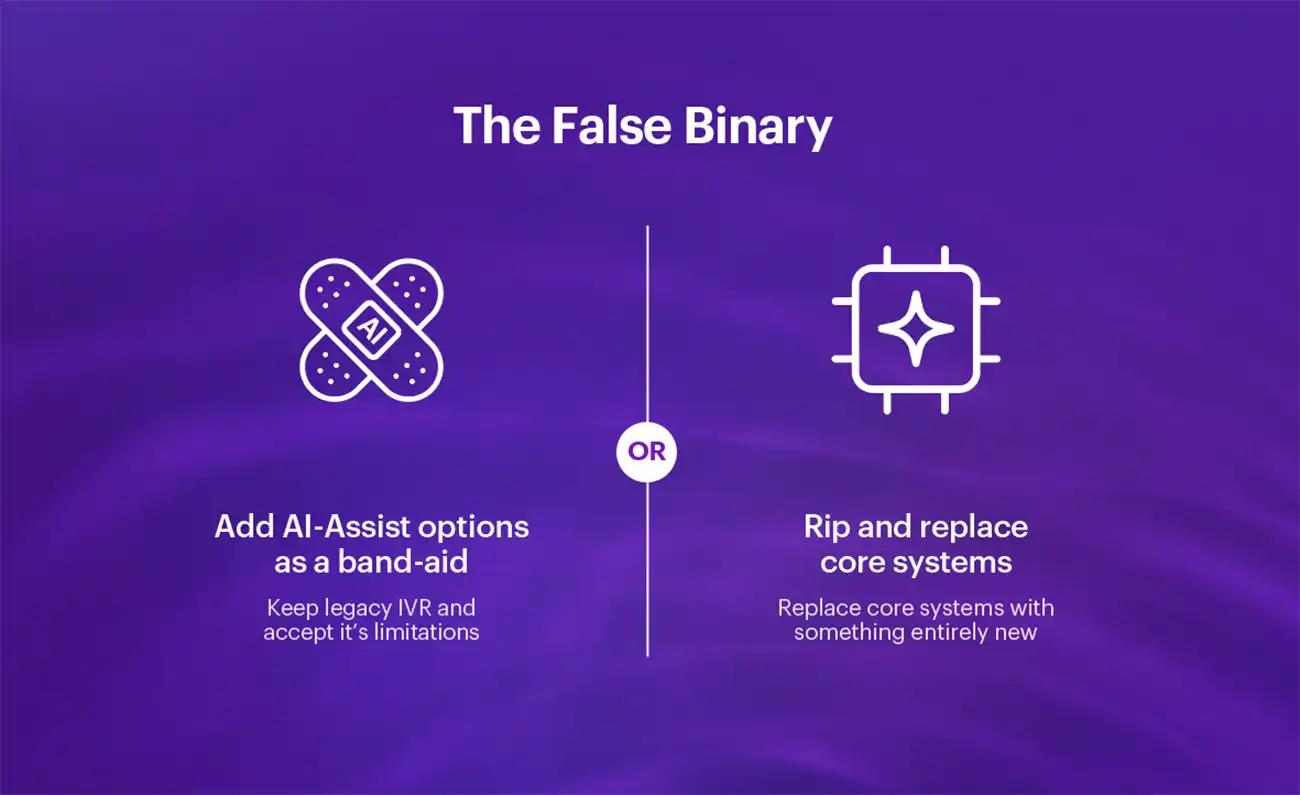
This diagnosis is now widely shared. Where enterprises diverge is in what to do about it. And here is where most go wrong, because the choice is almost always framed as a binary: bolt AI onto what you have, or rip everything out and start over.
The bolt-on approach is appealing for obvious reasons. It is low risk, fast to deploy, and easy to justify to a procurement committee. Suggested responses for agents. Real-time knowledge retrieval. After-call summarization. These tools have genuine value, and they are proliferating across the industry. But they share a hard ceiling: the human agent remains the primary service delivery mechanism. Peak volume still demands more headcount. After-hours coverage still requires staffing. Every improvement built on top of that assumption inherits the same scalability constraint that created the problem in the first place.
The rip-and-replace approach has the opposite problem. It is theoretically correct and practically terrifying. No enterprise with millions of customer interactions per year is going to shut down its contact center on a Friday and turn on an entirely new AI system on Monday. The operational risk is too high, the regulatory exposure too uncertain, and the organizational change management too complex.
So most enterprises end up stuck: they know the bolt-on approach has a ceiling, and they know the rip-and-replace approach has a cliff. They end up in a state of permanent incrementalism, layering tool after tool on top of infrastructure that was never designed for what they actually need it to do.
The better framing is not “how much AI do we add?” It is “how do we sequence a transition that compounds?”
The Compounding Sequence
The most important insight in any AI deployment strategy is that the right sequence creates data that makes the next stage possible. This is not a platitude; it is an architectural principle. And it is the reason the crawl, walk, run framework works where the binary framing fails.
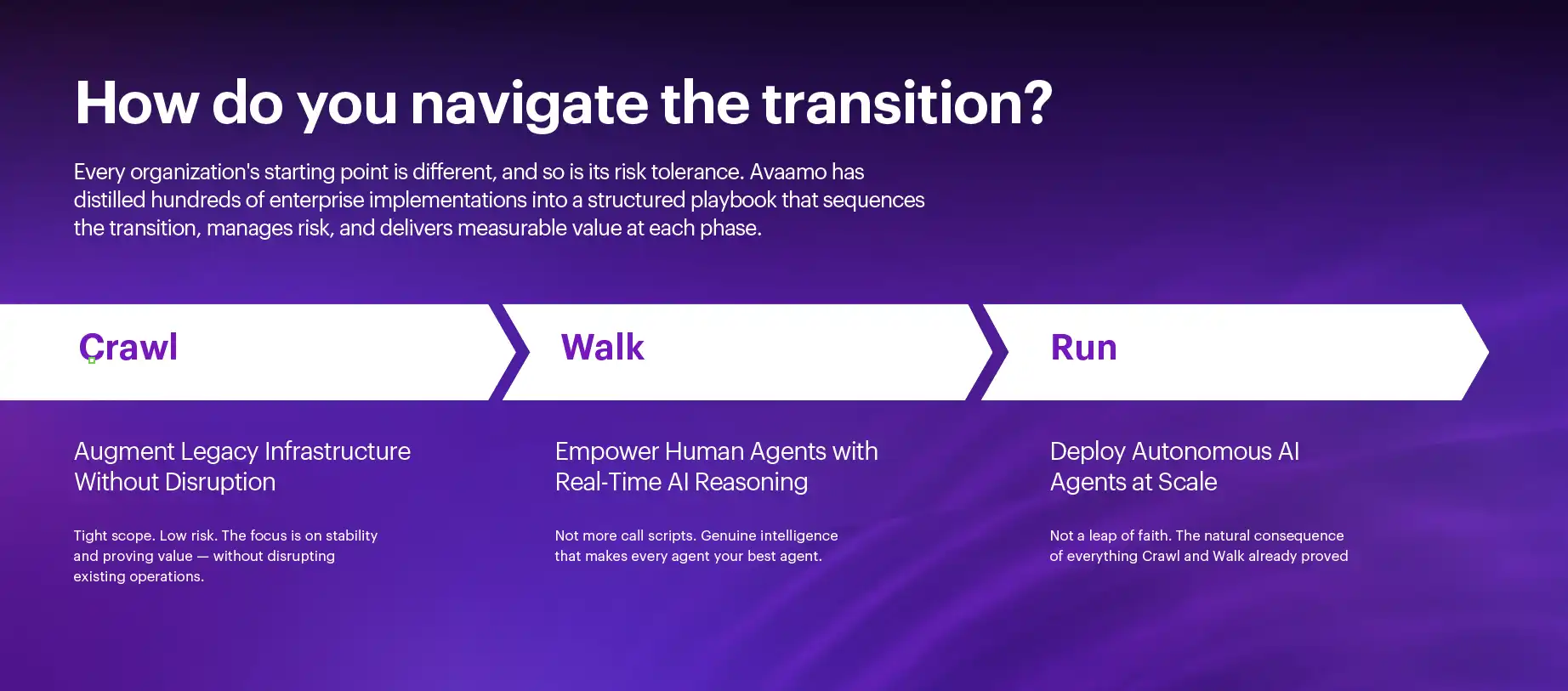
Crawl is the stage most enterprises skip, and it is the one that matters most. The instinct is to jump straight to automation: find your highest-volume call type and build a bot for it. This is almost always a mistake. You don’t yet know, with production-grade confidence, what your customers are actually calling about, how they describe their problems in natural language, which intents cluster together, or which resolution paths work.
Crawl starts above the existing stack, not inside it. You replace the IVR with a conversational AI layer that understands natural language from the first utterance, authenticates the caller, retrieves account context, and routes intelligently. The customer experience improves immediately: no menus, no dead ends, no “press 1 if you think your problem is billing.” But the more important outcome is not the routing itself. It is the data the routing generates.
Every call processed by the AI routing layer produces structured intent data: what the customer asked for, how they asked for it, what context was available, and where the call ultimately resolved. This is the dataset that makes Walk possible, and eventually Run. Without it, you are building automation on assumptions. With it, you are building on evidence.
Walk is where most enterprises expect to start, and where they should arrive second. The focus shifts from the customer’s entry point to the agent’s experience. For the interactions that genuinely require a human, the question becomes: what would it take to make every agent perform like your best agent?
The answer turns out to be context and timing. Before the call: a 360-degree customer view surfaces CRM history, open tickets, and account status before the agent picks up. During the call: contextual suggested responses, knowledge recommendations, and sentiment monitoring with de-escalation prompts. After the call: automatic summarization and promise management, auto-logged to CRM, eliminating after-call work entirely.
Walk does two things simultaneously. It makes human agents measurably more effective on complex calls. And it generates a second dataset: which AI suggestions agents actually accept, which resolution paths work, and which interaction types are ready for full AI resolution. Every accepted suggestion is a validated training signal. By the end of Walk, you do not need to guess which calls AI can handle autonomously. You have the data to prove it.
Run is where AI agents become a strategic capability, not a supporting tool. But the critical point is that Run is not a leap of faith. It is the natural conclusion of everything Crawl and Walk already proved. The routing layer has classified every interaction type. The copilot layer has validated which resolution paths work. You go into Run knowing exactly what AI can handle and with the production data to back it up.
These are not chatbots. They are purpose-built agents, each trained on specific products, policies, and workflows, each connected to systems of record and capable of taking real action: updating records, processing transactions, rescheduling appointments, confirming changes. A billing agent. A reservations agent. A claims agent. Each operating autonomously on the call types that Crawl identified and Walk validated.
Why Sequence Creates Advantage
The reason this framework works is the same reason platform businesses tend toward winner-take-most dynamics: the value compounds and the gap widens.
An AI-native contact center with two years of production data is not two years ahead of a legacy system that just launched a pilot. It is operating on an entirely different plane. Every interaction makes the next one more accurate. Every resolved call trains the next resolution path. The system gets smarter in a way that cannot be replicated by purchasing the same software later, because the advantage is not in the software; it is in the data and the validated resolution paths that only accumulate through production deployment.
This is the part that most enterprise leaders underestimate. The decision to wait is not neutral. It is a decision to let the gap compound against you.
Consider what happens when two competitors in the same industry take different approaches. Company A starts Crawl in Q1, reaches Walk by Q3, and enters Run by the following year. Company B decides to wait for “more mature” technology and launches a pilot eighteen months later. By the time Company B is in Crawl, Company A has autonomous agents resolving 70% of routine volume with continuously improving accuracy. Company B is not eighteen months behind. It is eighteen months behind and starting with no production data, no validated resolution paths, and no compounding advantage.
What I actually tell people
When someone asks me where to start, I tell them three things.
First: do not let perfection paralyze you. Crawl is deployable in weeks, not months. You are replacing an IVR, not rebuilding a space shuttle. The risk is low, the customer experience improvement is immediate, and the data you generate is the foundation for everything that follows.
Second: resist the temptation to skip ahead. I know you want AI agents. I know the board wants AI agents. You will get AI agents, and they will actually work, because you built them on data instead of assumptions. The companies that skip to Run and deploy agents that hallucinate their way through customer interactions end up further behind than when they started, because now they have to rebuild organizational trust in addition to rebuilding the technology.
Third: start. The cost of waiting is not zero. It is the compounding advantage you are not building. Every quarter you spend evaluating vendors and commissioning feasibility studies is a quarter of production data you will never get back. The insights come from deployment, not from planning.
The playbook is simple. The discipline to follow it is not. But after watching enterprise after enterprise get this right and get this wrong, I can tell you: the ones that sequence the transition always outperform the ones that skip steps. Always.
Every company wants to run. The ones that get there start by learning to crawl.
